Repaving a commercial parking lot is a significant investment, and it comes with legal responsibilities that go well beyond selecting the right asphalt mix. Any time a commercial property undergoes paving work, ADA compliance becomes a mandatory consideration, not an optional upgrade. Property owners and facility managers who overlook this risk face costly violations, legal exposure, and the expense of having work redone to meet federal standards.
The Americans with Disabilities Act has been in effect since 1990, and its requirements for accessible parking have been updated and clarified over the years. Many property owners are surprised to learn that repaving a lot, even a partial repave, can trigger the obligation to bring the entire accessible route up to current standards. Understanding those requirements before the project begins is the most efficient and cost-effective way to stay compliant.
This article covers what commercial property owners need to know about ADA compliance when planning a parking lot repaving project, from accessible space counts and dimensions to slope requirements and signage. Getting these details right from the start protects your property, your tenants, and the people who use your lot every day.
Why Repaving Triggers ADA Requirements
A common misconception is that ADA compliance only applies to new construction. In reality, the ADA requires that alterations to existing facilities improve accessibility to the maximum extent feasible. Repaving a parking lot is considered an alteration under federal guidelines, which means it activates the obligation to evaluate and address accessible features throughout the affected area.
The scope of what gets triggered depends on the nature and extent of the work. A full parking lot repave typically requires a comprehensive review of all accessible parking spaces, access aisles, pedestrian routes, and signage. Even a partial repave or resurfacing project can require upgrades if the work touches areas near accessible spaces or pedestrian pathways.
This is one of the most important reasons to work with a paving contractor who understands ADA compliance requirements and can identify compliance gaps during the planning phase. Discovering those gaps after the project is complete means additional mobilization costs, material expenses, and potential disruption to tenants and customers all over again.
Property owners should also be aware that local building codes may impose requirements that go beyond the federal ADA standards. In some jurisdictions, permits for paving work require a compliance review as part of the approval process. Checking with your local building department before the project begins is a smart first step.
How Many Accessible Spaces Are Required?
The number of accessible parking spaces required on a commercial property is determined by the total number of spaces in the lot. The ADA Standards for Accessible Design set out a clear ratio that scales with lot size. For a lot with 1 to 25 total spaces, one accessible space is required. That number increases progressively as the lot size grows, with larger facilities required to provide a proportionally higher count of accessible spaces.
Of the total accessible spaces required, at least one must be a van-accessible space. For lots with six or more accessible spaces, one in every six must meet van-accessible standards. Van-accessible spaces have wider access aisles to accommodate vehicles equipped with lifts or ramps, which require significantly more lateral clearance than standard accessible spaces.
When repaving triggers an accessibility review, the existing space count should be verified against current ADA compliance requirements. Lots that were striped years ago may fall short of today’s standards, either in the number of spaces or in the specific dimensions used. A qualified contractor can assess the current layout and identify exactly what changes are needed before the first layer of asphalt goes down.
Accessible Space Dimensions and Layout
The dimensional requirements for accessible parking spaces are specific and non-negotiable. A standard accessible space must be at least 8 feet wide, with an adjacent access aisle that is at least 5 feet wide. That access aisle must run the full length of the parking space and connect directly to the accessible route leading to the building entrance. Parking spaces that meet the width requirement but lack a compliant access aisle do not satisfy ADA compliance standards.
Van-accessible spaces require either a wider space of at least 11 feet with a 5-foot access aisle, or a standard 8-foot space with an 8-foot access aisle. Either configuration must provide enough clearance for a vehicle-mounted lift or ramp to deploy safely. This is a detail that often gets overlooked in older lots that were designed before van-accessible standards became clearly defined in the guidelines.
Access aisles between adjacent accessible spaces can be shared, meaning two accessible spaces can share a single aisle placed between them. This can help with lot layout efficiency when reconfiguring spaces during a repaving project. However, the shared aisle must still meet the width requirement for the type of space it serves, with van-accessible aisles taking precedence when one of the two spaces is van-designated.
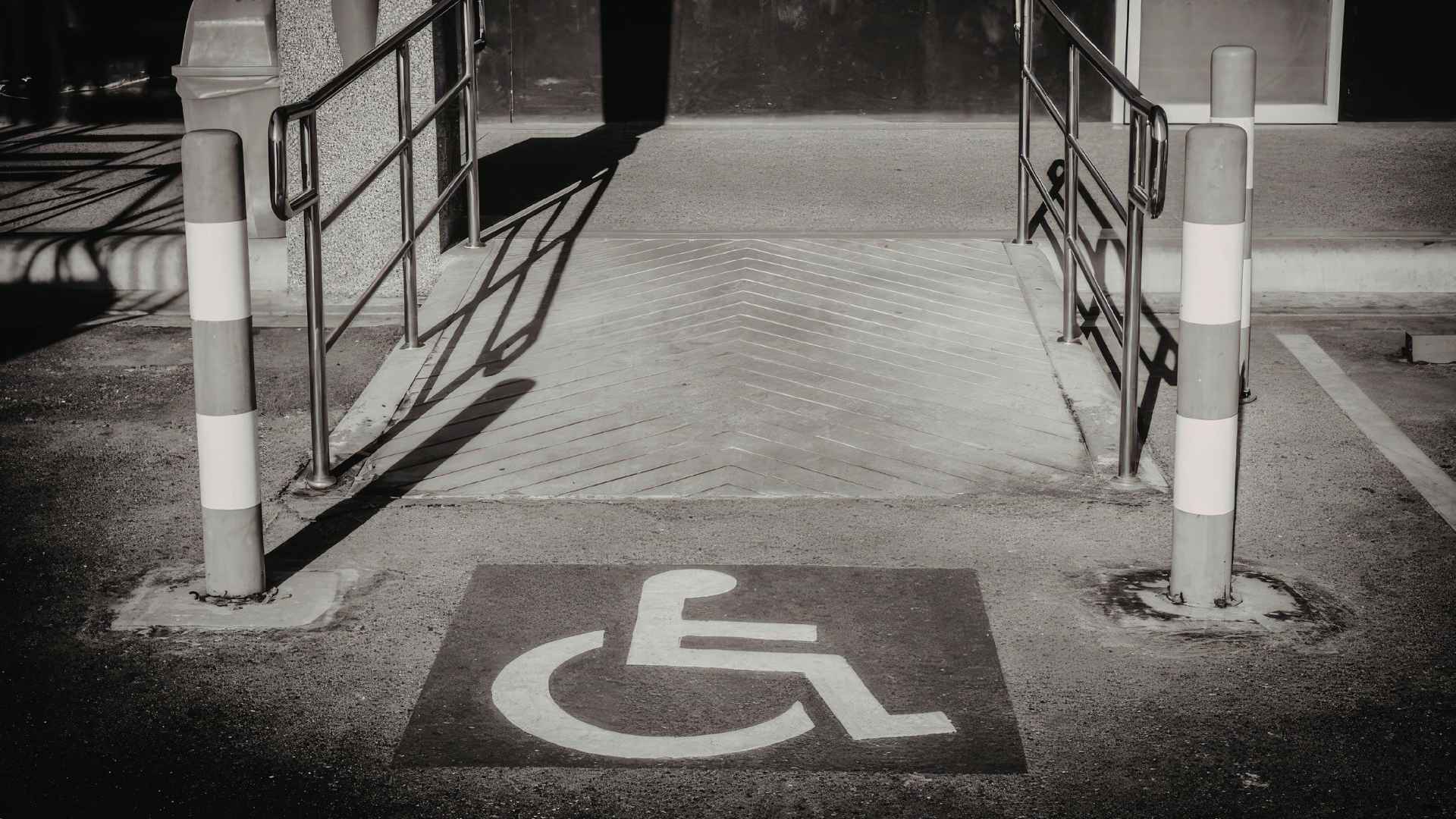
All accessible spaces and access aisles must be clearly marked with the International Symbol of Accessibility painted on the pavement surface. Markings that have faded or been obscured by repaving must be reapplied immediately as part of the project scope. Striping is not a finishing touch in the context of ADA compliance; it is a required element of a complete and legally usable accessible space.
Slope and Surface Requirements
Surface slope is one of the most technically demanding aspects of ADA compliance in parking lot design. The maximum allowable slope in any accessible parking space or access aisle is 1:48 in all directions, which works out to approximately 2%. Slopes that exceed this limit make it difficult or unsafe for wheelchair users to transfer in and out of vehicles, and they represent a direct ADA violation regardless of how well the rest of the space is designed.
Achieving and maintaining the correct slope in a parking lot requires precise grading work during the paving process. Existing lots often have slope irregularities caused by years of wear, patching, and settling. A repaving project provides the opportunity to correct those issues, but only if the contractor takes accurate measurements and grades the surface accordingly before laying new asphalt. Paving over an out-of-spec surface without correcting the grade simply transfers the problem into the new pavement.
The accessible route connecting parking spaces to the building entrance must also meet slope requirements. The route cannot exceed a running slope of 1:20 and a cross slope of 1:48 unless it is designed as a ramp with handrails and other required features. If the pedestrian path from the accessible spaces to the building entrance involves significant grade changes, those areas need to be evaluated and potentially redesigned as part of the repaving project.
Surface texture matters as well. The ADA requires that accessible routes be stable, firm, and slip-resistant. Fresh asphalt that is properly compacted and finished generally meets this standard, but deteriorated or patched surfaces may not. Any accessible route that feels unstable underfoot or collects standing water due to low spots or drainage issues should be addressed as part of the paving scope.
Signage and Vertical Clearance Requirements
Accessible parking spaces must be marked with signs that display the International Symbol of Accessibility. These signs must be mounted so that the bottom of the sign is at least 60 inches above the ground, which keeps them visible even when a vehicle is parked in the space. Signs that are painted only on the pavement surface do not satisfy this requirement on their own; a vertical sign is always required.
Van-accessible spaces require an additional sign reading “Van Accessible” mounted below the main accessible parking sign. This distinction helps drivers of van-equipped vehicles identify the specific spaces designed for their needs, which improves lot function and reduces conflicts over space usage. Replacing or adding signage during a repaving project is far simpler than returning later to install posts and hardware after the lot has reopened.
If the accessible parking area is covered by a structure such as a parking deck or canopy, vertical clearance requirements also apply. Van-accessible spaces must have a minimum vertical clearance of 98 inches throughout the vehicle route from the entrance to the space and throughout the access aisle. This requirement exists to accommodate the height of vehicles with rooftop lifts, which are common among wheelchair users.
The Accessible Route From Parking to Entry
ADA compliance does not stop at the parking space itself. The accessible route from the parking area to the primary building entrance is a required element that must be evaluated as part of any parking lot repaving project. That route must be free of steps, have compliant cross slopes, and provide a continuous path that does not require a person using a wheelchair or mobility device to travel behind parked vehicles or into traffic lanes.
Curb ramps are typically required wherever the accessible route crosses a curb or changes elevation between the parking surface and a sidewalk or building entrance. These ramps must meet specific slope, width, and flare requirements under ADA compliance guidelines. Ramps that were installed years ago may no longer meet current standards and should be assessed and potentially rebuilt during the repaving project to avoid a compliance gap at the very end of the accessible route.
According to the U.S. Department of Justice Civil Rights Division, one of the most common sources of ADA violations in commercial parking lots is the failure to provide a compliant accessible route from the parking space to the building entrance. Meeting the dimensional requirements of the parking space itself is only half of the compliance picture; the entire path of travel must be evaluated and addressed.
Common Mistakes That Lead to Non-Compliance
One of the most frequent errors property owners make is assuming that because a lot was compliant when it was originally built, it remains compliant today. Standards have been updated over the years, and a lot that passed inspection a decade ago may fall short of current requirements. Any repaving project is an opportunity to close those gaps, and failing to do so while work is already underway is a missed opportunity that will cost more to correct later.
Another common mistake is placing accessible spaces in a location that is technically within the parking lot but far from the building entrance. ADA compliance requires that accessible spaces be located on the shortest accessible route to the entrance they serve. A cluster of accessible spaces at the far end of a large lot does not satisfy the requirement simply because the spaces themselves meet dimensional standards.
Delegating compliance decisions entirely to the paving contractor without involving a qualified accessibility consultant or reviewing the ADA Standards for Accessible Design is also a risk. Not all paving contractors have deep familiarity with the full scope of ADA requirements, particularly the slope tolerances and accessible route standards that go beyond striping and signage. Property owners retain responsibility for compliance regardless of who performs the work.
Planning Ahead Saves Time and Money
The most cost-effective approach to ADA compliance in a parking lot repaving project is to address it during the design and planning phase, before any equipment is mobilized. Identifying the number of required accessible spaces, verifying the layout, confirming slope requirements, and reviewing the accessible route all take time upfront, but eliminate the much greater expense of corrective work after the fact.
Including accessibility improvements in the base scope of the paving project also allows the contractor to sequence the work efficiently. Grading for slope compliance, installing or relocating curb ramps, and reconfiguring space layouts are all far simpler to accomplish while the lot is already torn up and the crew is on-site. Adding those elements after the fact requires remobilization, additional material, and in some cases, cutting into new pavement that was just placed.
Documenting the compliance measures taken during the project is also a smart practice. Keeping records of the accessible space count, the dimensions used, slope measurements, and signage installed creates a paper trail that can be valuable if the property is ever audited, sold, or the subject of a complaint. Good documentation demonstrates good faith and thoroughness in meeting ADA compliance obligations.
Final Thoughts
Repaving a commercial parking lot is an opportunity to do more than lay fresh asphalt. It is a chance to bring the property into full ADA compliance, improve safety and accessibility for every visitor, and reduce the legal and financial risk that comes with non-compliant facilities. Property owners who treat accessibility as a core part of the project scope rather than an afterthought consistently get better outcomes at a lower total cost.
The requirements are detailed, the tolerances are precise, and the consequences of getting it wrong are real. Working with an experienced commercial paving contractor who takes ADA compliance seriously from the first planning conversation is the most reliable way to make sure your repaving investment delivers lasting value and keeps your property on the right side of the law.
Have questions about your upcoming parking lot project? Contact D&H Asphalt today to schedule a free consultation and make sure your repaving project meets every ADA compliance requirement from the ground up.